How to Find Your Japanese Ancestors Without Reading Japanese
Published Updated By TADOROOTS Research Team
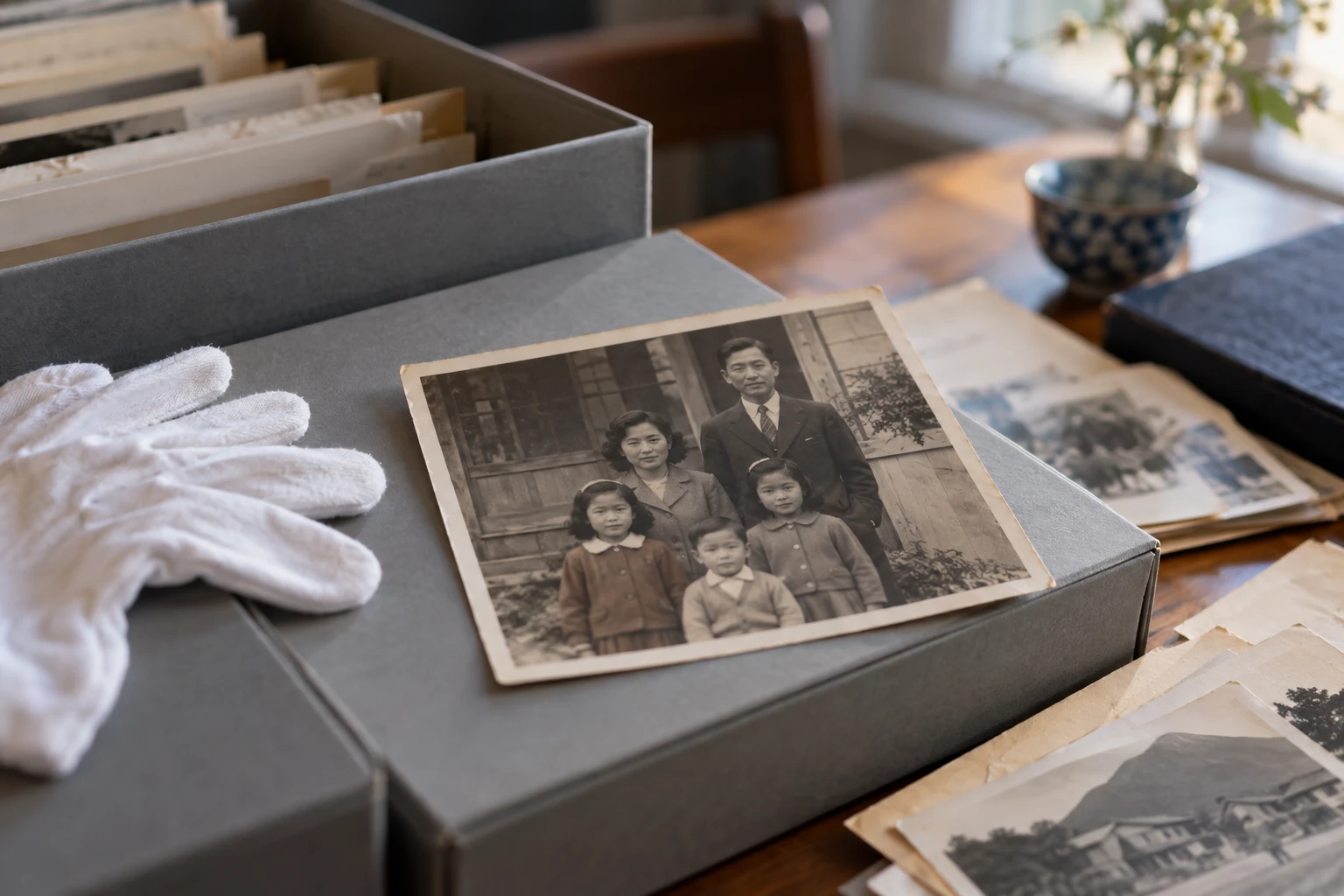
Maybe it started with an old photograph. A great-grandmother in a kimono, a name written on the back in characters you can't read, and a question nobody in the family can answer anymore: where in Japan did she come from?
If that sounds familiar, you're far from alone. Many people with Japanese roots — in the United States, Canada, Brazil, Peru and beyond — start with exactly this much, and feel stuck because they don't read Japanese. Here is the good news: not reading Japanese is not what stops most searches. What matters far more is knowing which record to ask for, where it is kept, and who is allowed to ask.
We're the research team at TADOROOTS in Tokyo. We read old Japanese family registers every day to build family trees, including for Nikkei families abroad. In this article you'll learn:
what the Japanese family register (koseki) is, and why it is the key record
why the family's "registered home" (honseki) matters more than where they lived
who can request a koseki, and how that works from outside Japan
what you can do this week, in English, to get closer
What is the koseki, and why is it the key record?
The koseki is Japan's official family register: a record kept by each family's home town that lists every member of a household with their births, marriages, adoptions and deaths. It has no real equivalent in the US or UK, where you might search separate birth, marriage and census indexes. In Japan, the family register does that job in one place.
Two features make it so useful for genealogy:
One register shows a whole household. Before 1948, registers were organized around the head of the household, so a single register can show three or four generations — parents, children, siblings, spouses — on the same pages.
Each register points to the previous one. When someone marries, is adopted or the register is rewritten, the entry notes where the person came from. You follow those pointers back, one register at a time.
The oldest registers you can generally obtain today are in the 1886 (Meiji 19) format. Even so, they often record people born in the late Edo period — the early to mid-1800s — because the household members were already alive when the register was made. (The very first national registers of 1872 are sealed and cannot be viewed.)
Why the family's "registered home" matters more than where they lived
A koseki is kept by the town office of the family's registered home (honseki), not by the place where they actually lived. This is the single most important idea in Japanese genealogy, and the one that trips up most first searches.
A family could live in Tokyo for decades while their register stayed in a small village in Hiroshima or Kumamoto. Emigrants usually left with their register still in their home village. So the question to answer first is not "where did they live?" but "where was the family registered?"
The good news: that village often appears in records outside Japan. Places to look include:
Ship passenger lists from arrival in Hawaii, the US mainland or other countries, which sometimes give a prefecture or village
Naturalization papers and alien registration files, which may name a birthplace
Wartime records for Japanese American families, such as the War Relocation Authority data held by the U.S. National Archives
Gravestones, family letters and Buddhist altar tablets kept at home, which may carry a village name in kanji
Even a prefecture name and a rough emigration year narrow things down a great deal.
Who can request a koseki?
Under Japan's Family Register Act (Article 10), the people named in a koseki, their spouses, and their direct ancestors and descendants can request a copy without giving a reason. For you, that usually means the registers of your parents, grandparents, great-grandparents and so on, in an unbroken line.
Relatives outside that line — the families of great-uncles, aunts, cousins or in-laws — cannot request those registers freely. They need a specific legal reason, such as confirming heirs, and curiosity about family history alone does not qualify (Article 10-2). That's not a barrier to most searches: your own direct line is usually exactly what you want to trace.
Because a koseki is a protected record, the request must show your line of descent. From abroad, that usually means connecting yourself to the Japanese ancestor through documents such as birth certificates, with translations.
How does requesting a koseki work from outside Japan?
From abroad, koseki are requested by post from the town office of the family's registered home, and the request and the reply are both in Japanese. A few practical points help to know in advance:
Fees are 450 yen per current register and 750 yen per closed or older register. They are normally paid with Japanese postal money orders (teigaku kogawase), which are hard to get outside Japan.
Timing: each request and reply by post commonly takes a few weeks, and each register you receive tends to point to the next one you need.
The 2024 one-stop service doesn't help from abroad. Since March 2024, people in Japan can request registers from all over the country at one town office — but only in person, at a counter in Japan, for themselves, their spouse or their direct line. It can't be used by mail or through someone else.
This is why many families abroad choose to work with someone in Japan. The request itself is still made on the written authorization of a direct-line descendant, so the right to the records always stays with the family.
What can you do this week, in English?
You can make real progress before anyone in Japan is involved. Try these four steps:
Write down every fragment. Names (even just a surname), a prefecture, a port, a ship name, a year of arrival, a religion, a family story. Small details often turn out to be the key.
Gather the documents already in your family. Birth, marriage and death certificates for each generation back to the person born in Japan. You'll need this chain of descent later anyway.
Search the records in your own country. Ship manifests, naturalization files, census records and, for Japanese American families, the National Archives' searchable War Relocation Authority database.
Photograph anything with Japanese writing on it — the back of photos, gravestones, letters, a household altar. Don't try to guess the kanji yourself; a clear photo is far more useful than a guess.
Reading the records: where the language really matters
The part of the work that truly needs Japanese is reading the registers themselves. Records made before computerization (from the mid-1990s onward, depending on the town) are handwritten, often in older characters and old-style dates such as "Meiji 22" rather than 1889. Names can be read in more than one way, and a single misread character can send a search down the wrong family.
That's why we suggest one rule: never guess the kanji of a surname. Keep the romanized spelling you have, keep every document, and let the original record decide.
In summary
The koseki, Japan's family register, is the key record, and it is kept at the family's registered home (honseki), not where they lived.
You can request your own direct line's registers. From abroad, it's done by post, in Japanese, and it takes patience.
You can start today in English: collect fragments, documents and photos, and search the records in your own country.
A single name is often enough to begin. Many families who thought they knew "almost nothing" end up with a family tree reaching back to ancestors born before 1868.
How TADOROOTS can help
We help Nikkei families abroad go from fragments to a family tree. We work out which registers to request and from which town, prepare the paperwork for the direct-line descendant's authorization, read the old handwritten registers, and turn them into an English family tree and report. When the family's registered home isn't known yet, we start by finding it. You can see how our step-by-step pricing works — the first step is a small pre-research, so you know what is possible before deciding more. We can work with you in English, Chinese, Korean or Japanese.
Frequently asked questions
Q. Do I need to speak or read Japanese to trace my Japanese ancestors?
No. You can collect documents, search records in your own country and photograph anything written in Japanese without reading it. The step that needs Japanese is reading the registers themselves, and that is where a native-reading researcher helps.
Q. What is a koseki?
A koseki is Japan's official family register. It lists the members of a household with their births, marriages, adoptions and deaths, and notes the register each person came from, so families can be traced back one register at a time.
Q. How far back can a koseki go?
The oldest registers generally available are in the 1886 (Meiji 19) format. Because they list household members who were already alive then, they often reach ancestors born in the late Edo period, in the early to mid-1800s, as long as the older registers have not been destroyed.
Q. Can I request a koseki from outside Japan?
Yes, by post, if you are a direct-line descendant of the person in the register. The request is in Japanese, fees are normally paid with Japanese postal money orders, and each exchange by post commonly takes a few weeks.
Q. Can a cousin or a niece request the koseki?
Not freely. Relatives outside the direct line need a specific legal reason, such as confirming heirs, under Article 10-2 of the Family Register Act. Interest in family history alone does not qualify.
Q. What if I don't know which town my family came from?
That's common. The registered home is often found in ship passenger lists, naturalization papers, wartime records, gravestones or family letters. Even a prefecture and a rough year of emigration help narrow it down.
Q. Do I need to travel to Japan?
No. Records are requested and returned by post. A trip becomes worthwhile later, once the research has found the hometown — many families then visit the place and the family grave.