Japanese American WWII Incarceration Records for Families
Published Updated By TADOROOTS Research Team
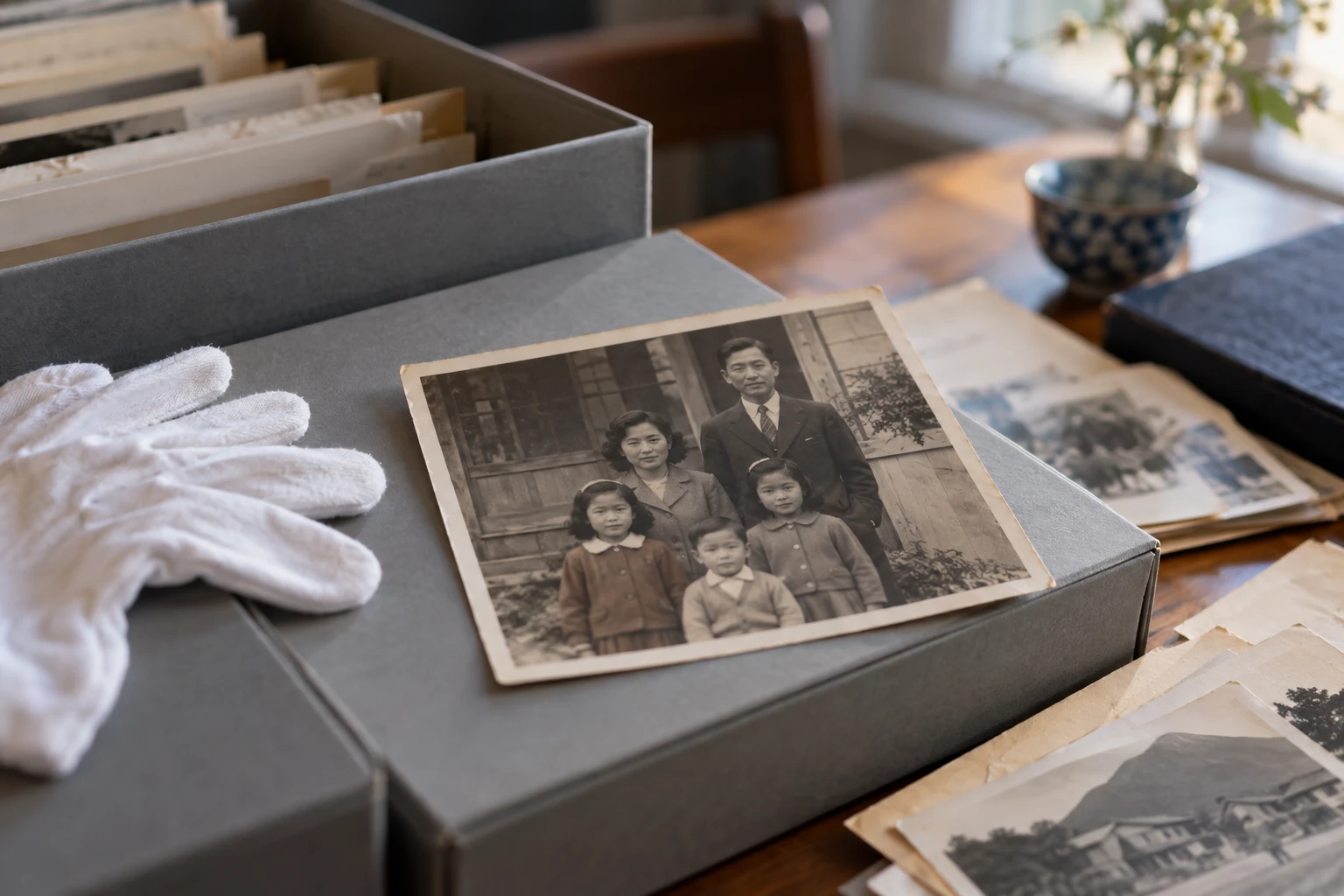
Maybe your grandparents rarely spoke about the war years. Perhaps there is a photo taken in front of a barrack, or a name of a camp that came up once at a family gathering and then quietly disappeared from conversation. Now you'd like to know more — about them, and about where in Japan the family began.
If that's where you are, you're far from alone. Many Japanese American families start their research with exactly these fragments, and with mixed feelings about looking. Here is something worth knowing: the U.S. government's own wartime records often hold the clearest written trace of an ancestor, and they can also be a bridge back to Japan.
We're the research team at TADOROOTS in Tokyo. We read old Japanese family registers every day to build family trees, including for Nikkei families abroad. In this article you'll learn:
what records were created during the WWII incarceration, and what they can contain
how to search them by name, and who can see the detailed case files
how these records connect to the Japanese family register (koseki)
how to approach this history with care
What happened, and why does it matter for family history?
Between 1942 and 1946, the U.S. government forcibly removed and incarcerated about 120,000 people of Japanese ancestry, about two-thirds of them U.S. citizens. The injustice was real, and so was the paperwork: agencies recorded each person and family in detail.
Most people were first held at temporary "assembly centers," often converted fairgrounds or racetracks, and then sent to one of ten War Relocation Authority (WRA) camps:
California: Manzanar, Tule Lake
Arizona: Poston, Gila River
Colorado: Granada (Amache)
Wyoming: Heart Mountain
Idaho: Minidoka
Utah: Topaz
Arkansas: Jerome, Rohwer
Tule Lake was the last to close, in March 1946. Some Issei (the immigrant generation) were also arrested and held separately in Department of Justice or Army camps. Issei could not become U.S. citizens until 1952, which is part of why they were treated as "enemy aliens."
What do the incarceration records contain?
The WRA records can show an ancestor's name, camp, family number, birth year, prewar address and occupation, and the individual case files may hold much more. According to the U.S. National Archives, case files vary but can include medical, school and property records, leave or discharge papers, correspondence and information about other family members.
Two kinds of records are especially useful:
Evacuee Summary Data Cards (1942–1946): basic information gathered soon after people entered the camps. This data is searchable by name online.
Final Accountability Rosters (1944–1946): lists made as the camps prepared to close, showing how each person entered and left — for example, by indefinite leave, transfer or relocation.
The family number is a small but valuable detail. Members of one family usually share the same number, with a letter marking each person's place in the family, so it helps you find parents, siblings and children together.
How do you search them?
Start with the U.S. National Archives' free online database of people held in the WRA camps, which you can search by name. It's part of the Archives' Access to Archival Databases (AAD), and the National Archives' "Search the Database" page explains how to use it.
A few tips from experience:
Try every spelling. A surname might be romanized more than one way, and some people used both a Japanese and an English given name.
Search by camp if a common surname gives too many results.
Note the family number and birth year of each person you find; you'll need them later.
Keep in mind that the database generally doesn't include people who were born in the camps.
To see a full WRA case file, you request it from the National Archives in Washington, DC. Because the files are subject to privacy rules, they are released to the person named in the file, to others with that person's written consent, or, if the person has died, generally on proof of death such as a death certificate or obituary.
How do these records connect to Japan?
Wartime records are often the bridge between an American family story and the Japanese family register, because they can confirm who your Issei ancestor was before you look in Japan. A name, a birth year, a prewar address and the names of family members help make sure that the person in a Japanese record is truly your ancestor.
The key you're looking for is the family's registered home (honseki) in Japan, the town where the koseki was kept. Emigrants usually left with their register still in their home village. Clues to that village can come from:
Passenger lists from arrival in Hawaii or the U.S. mainland, which sometimes give a prefecture or village
Immigration and alien registration files held by the National Archives
Japan's prewar passport records, kept at the Diplomatic Archives of the Ministry of Foreign Affairs
Family items such as letters, gravestones and Buddhist altar tablets with Japanese writing
Once the honseki is known, the koseki can be requested from that town office, by post, on the written authorization of a direct-line descendant. The oldest registers generally available are in the 1886 (Meiji 19) format, so a family line can often be traced back into the early to mid-1800s.
How can you approach this material with care?
There is no right way to feel about these records; taking your time and sharing the findings at your own pace is part of doing this well. Families respond with grief, anger, pride in how their elders endured, or all of these at once.
Some families find it helps to:
read the records first, before sharing them widely
talk with older relatives gently, without expecting them to revisit everything
keep copies for the whole family, so the next generation can know the story
In summary
About 120,000 people of Japanese ancestry were incarcerated, and the records made then often hold detailed traces of each family.
The National Archives' online database is searchable by name, and full case files can be requested under privacy rules.
These records can confirm who your ancestor was, and help find the family's registered home in Japan.
The camp years are one chapter of your family's story, and the records from that time can lead you to the chapters that came before.
How TADOROOTS can help
We help Japanese American families connect what they've found in U.S. records to the family's roots in Japan. We work out the family's registered home, identify which registers to request and from which town, prepare the paperwork for the direct-line descendant's written authorization, read the old handwritten registers, and build a family tree with an English report. You can see how our step-by-step pricing works. We can work with you in English, Chinese, Korean or Japanese.
Frequently asked questions
Q. How do I find out which camp my family was sent to?
Search the U.S. National Archives' free online database of people held in the WRA camps, part of its Access to Archival Databases (AAD), by name. Each record shows the camp, and often the assembly center, family number and birth year. Try every spelling of the surname.
Q. Who can see a WRA case file?
WRA case files are subject to privacy rules. They are released to the person named in the file, to others with that person's written consent, or, if the person has died, generally on proof of death such as a death certificate or obituary.
Q. Why can't I find a relative who was born in a camp?
The National Archives notes that its online database generally doesn't include people born in the WRA camps. They may still appear in the Final Accountability Rosters or in a parent's case file.
Q. What is a family number?
It is a number the WRA gave to each family entering a camp. Members of one family usually share the same number, with a letter showing each person's position, which helps you find relatives together.
Q. Do incarceration records show where in Japan my ancestor came from?
Sometimes they give useful clues, but the town in Japan is more often found in passenger lists, immigration files, prewar passport records or family items. The wartime records are most useful for confirming who your ancestor was.
Q. Can I trace the family in Japan after finding these records?
Yes, often. Once the family's registered home is known, the Japanese family register can be requested on the written authorization of a direct-line descendant, and older registers can lead back to ancestors born in the 1800s.
Q. Were all Japanese Americans incarcerated?
No. The mass removal mainly affected people living on the West Coast. Families elsewhere in the United States and in Hawaii were generally not removed in the same way, though some individuals were arrested and detained.