How to Read a Japanese Family Tree Built From Koseki
Published Updated By TADOROOTS Research Team
Perhaps a relative finally shared the family tree, or a copy of an old register arrived in the mail. You open it, and instead of the neat pedigree chart you expected, you see dates like "Meiji 22," an ancestor who seems to have two surnames, and an adoption no one in the family ever mentioned.
If that's where you are, you're far from alone. Many people with Japanese roots feel a little lost the first time they see a tree built from Japanese records. Nothing is wrong with your tree — it simply follows Japanese conventions, and a handful of them explain almost everything that looks strange.
We're the research team at TADOROOTS in Tokyo. We read old Japanese family registers every day to build family trees, including for Nikkei families abroad. In this article you'll learn:
how to convert Japanese era dates such as "Meiji 22" into Western years
why the same ancestor can appear under more than one name
why adoptions appear so often, and what they meant
how to follow the generations down the page, and what to do when something doesn't match the family story
Where does a Japanese family tree come from?
Most Japanese family trees for genealogy are built from the koseki, Japan's official family register, which records each household's births, marriages, adoptions and deaths. The register is kept by the town office of the family's registered home (honseki), and each register notes where a person came from and where they went, so a researcher can follow the family back one register at a time.
Two things about the koseki shape the tree you hold:
Before 1948, registers were organized around the head of the household. One register can show three or four generations together — the head, his parents, his wife, children, and sometimes brothers and their families.
The oldest registers generally available are in the 1886 (Meiji 19) format. Because they list people already alive at the time, a tree can often reach ancestors born in the late Edo period, in the early to mid-1800s.
How do you read Japanese era dates?
Japanese records count years by era name, so "Meiji 22" means the 22nd year of the Meiji era, which is 1889. A well-prepared tree converts dates into Western years, but the original registers show era dates, so it helps to know the pattern.
Era (years)
To convert, add
Meiji (1868–1912)
1867
Taisho (1912–1926)
1911
Showa (1926–1989)
1925
Heisei (1989–2019)
1988
Reiwa (2019–)
2018
For example, Taisho 5 is 1916 and Showa 20 is 1945. One small caution: Japan switched to the Western (Gregorian) calendar on January 1, 1873 (Meiji 6). Dates before that follow the old lunar-solar calendar, so a birth "in the 3rd month" of an earlier year doesn't fall in March, and a converted date may be a few weeks off. A careful tree keeps the original wording next to the conversion.
Why does the same ancestor appear under different names?
One ancestor can appear under more than one surname because marriage and adoption could legally move a person into another family's register and give them that family's name. This is not a research error; it is how the system worked.
Common examples you may see:
A wife entering her husband's register. Before 1948, a bride usually left her father's register and entered her husband's, taking his family name.
A son-in-law adopted into his wife's family (mukoyoshi). When a family had no son to carry on the household, a daughter's husband could be adopted and take her family's surname.
An ordinary adoption between relatives or friends, which might move a child into another branch of the family.
Given names can be confusing too. Old registers write names in kanji or kana but don't record how a name was pronounced, and many kanji names can be read in more than one way. That's why we never guess the reading of a name from the characters alone; other records, family memory and the original register together decide.
Why are there so many adoptions?
Adoption appears often in Japanese family trees because it was a normal legal way to keep a household and its name going, not a sign of anything unusual. Families adopted adult sons-in-law, nephews and younger brothers as well as children, often to choose an heir for the household.
So if your tree shows two or three adoptions across five or six generations, that is quite ordinary. Each adoption is also useful for research: the register records the family the person came from, which can open a whole new branch of your tree.
How do you follow the generations?
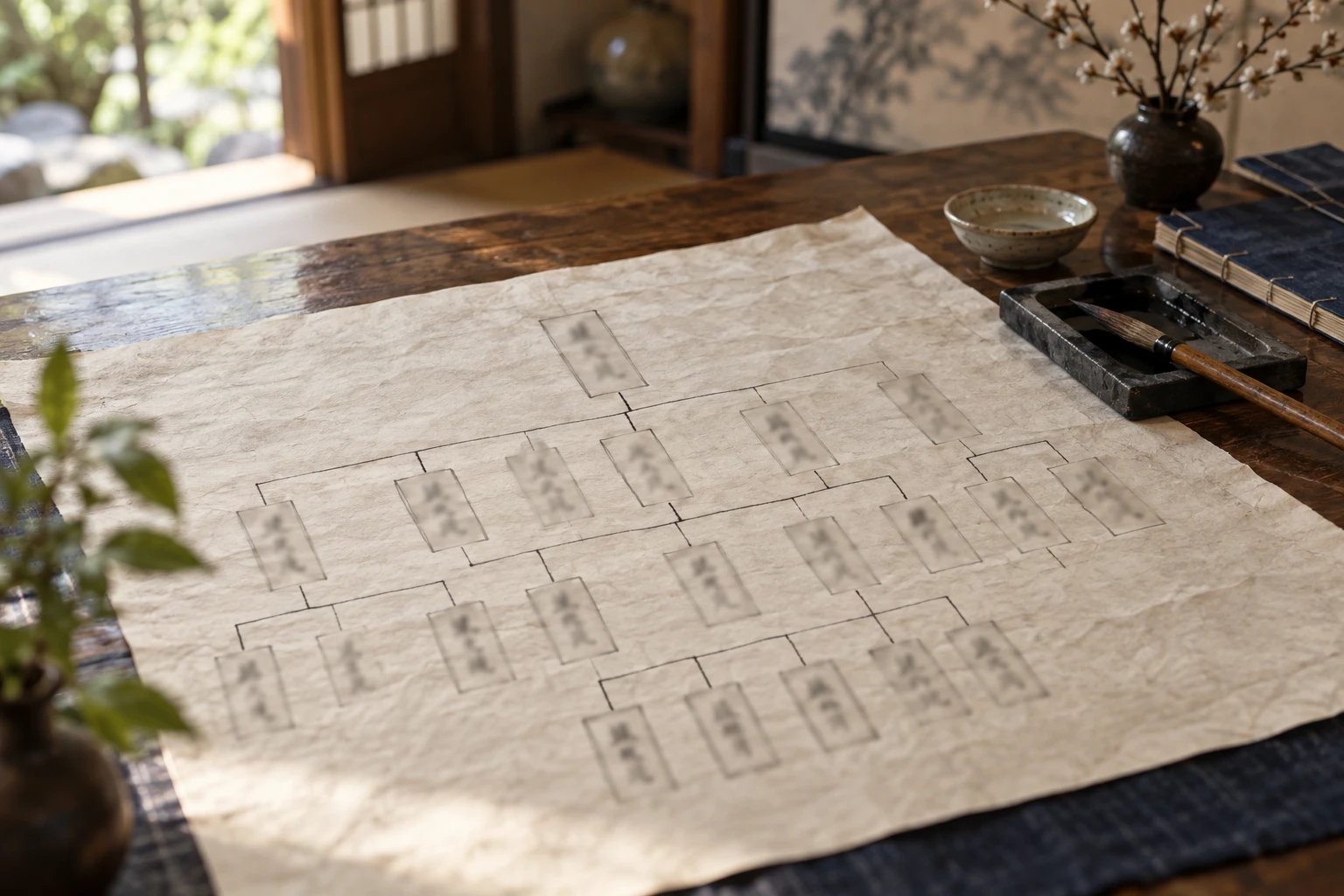
A Japanese family tree is usually read from top to bottom by generation, with siblings placed side by side within each generation. Instead of fanning out from one person like a Western pedigree chart, it often starts with the oldest known ancestor at the top and moves down toward you.
A few tips make it easier:
Find yourself, then trace upward. Put a finger on your own name or your parent's and follow the line up, one generation at a time.
Look for the line that joins a couple (often a double line) and the vertical line down to their children.
Read the birth-order labels. Registers describe children as "eldest son," "second daughter" and so on, which tells you their order among siblings.
Expect some empty spaces. A person may appear only as a parent's name in someone else's entry, so their own birth date was never recorded there. A good tree says so rather than guessing.
What if something doesn't match the family story?
When the tree and the family story disagree, it's worth asking about the difference instead of assuming either one is wrong. Family memory and the legal register sometimes record different things, and both can be true in their own way.
Some common reasons:
A child was raised by relatives, but the adoption was never formally registered — or the reverse.
A name was written one way in Japan and spelled another way abroad.
A birth date on a later document came from memory, while the register recorded it at the time.
A good researcher walks you through each difference and shows which record says what, so you can decide how to tell the story.
In summary
Japanese family trees are usually built from the koseki, and they read top to bottom by generation.
Era dates convert with a simple addition, but dates before 1873 follow the old calendar.
Name changes and adoptions are normal parts of Japanese family history, and each one can lead to a new branch.
Once you know these few conventions, the tree stops looking foreign — and the people in it start to feel like family.
How TADOROOTS can help
We build family trees from the original Japanese registers for families in Japan and abroad. We work out which registers are needed and from which town, prepare the paperwork for the written authorization of a direct-line descendant, read the old handwritten entries, and turn them into an easy-to-follow tree with an English report explaining how to read it. You'll also have time to ask about anything that doesn't match what you expected. You can see how our step-by-step pricing works. We can work with you in English, Chinese, Korean or Japanese.
Frequently asked questions
Q. What does "Meiji 22" mean on a Japanese family tree?
It means the 22nd year of the Meiji era, which is 1889. To convert a Meiji year, add 1867. For Taisho add 1911, for Showa add 1925, for Heisei add 1988 and for Reiwa add 2018.
Q. Why does my ancestor have two different surnames?
Marriage and adoption could legally move a person into another family's register and give them that family's name. Before 1948 a wife usually took her husband's family name, and a son-in-law adopted into his wife's family (mukoyoshi) took hers.
Q. Is it unusual to see several adoptions in one Japanese family tree?
No. Adoption was a common legal way to keep a household and its name going, and adult sons-in-law, nephews and younger brothers were often adopted as heirs. Several adoptions across generations are quite ordinary.
Q. Why do some relatives have no birth date?
Some people appear in the registers only as a name, for example as a parent mentioned in someone else's entry, so no birth date was recorded for them there. A careful tree marks the date as unknown instead of guessing.
Q. Are converted dates before 1873 exact?
Not always. Japan adopted the Western calendar on January 1, 1873. Earlier dates follow the old lunar-solar calendar, so a converted year is right but the month and day may be a few weeks off from the Western date.
Q. What should I do if the tree doesn't match what my family remembers?
Ask about the difference rather than assuming an error. Family memory and the legal register can record different things, such as an adoption that was never registered, and a researcher can show you which record says what.
Q. Can a family tree be updated later?
Yes. If a visit to the hometown, further research or a newly found relative adds information, the tree can be revised to include it.