Japanese Ancestry in Your DNA Test? Next Steps That Work
Published Updated By TADOROOTS Research Team
You open the results page, and there it is: a slice of the chart marked "Japanese." Maybe you expected it. Maybe it was a complete surprise. Either way, the next question arrives quickly — who was this ancestor, and where in Japan did they come from?
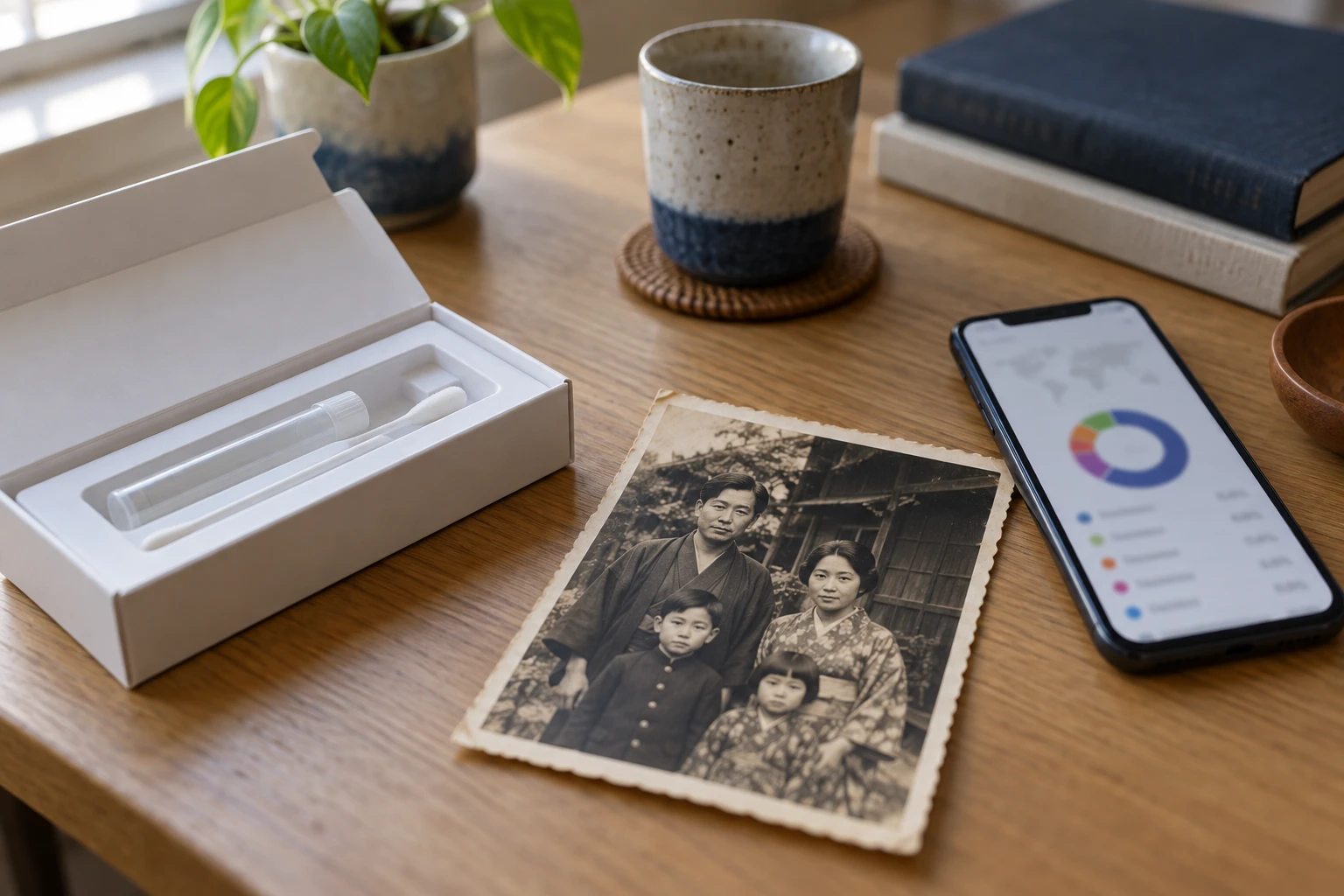
If you're sitting with that question, you're far from alone. Many people with Japanese roots start their family history with a DNA kit from a service such as AncestryDNA or 23andMe, then find the result raises more questions than it answers. A DNA result is a real and useful clue — it just needs records to turn it into a family story.
We're the research team at TADOROOTS in Tokyo. We read old Japanese family registers every day to build family trees, including for Nikkei families abroad. In this article you'll learn:
what a DNA result can and can't tell you about Japanese ancestry
how to turn each kind of result into a practical lead
why matches in Japan are rarer than you might expect
how DNA connects to Japan's family register, the koseki
What can a DNA test tell you about Japanese ancestry?
A DNA test can suggest that you have Japanese ancestry and sometimes connect you with living relatives, but it cannot tell you an ancestor's name, hometown or story. The percentage you see is an ethnicity estimate, worked out by comparing your DNA with reference groups. It is a hint, not a measurement.
What a test can often do:
Suggest Japanese ancestry and give a rough sense of how many generations back it may enter your tree
Show matches — other testers who share DNA with you and are likely relatives
Point to a region, as some services now break Japanese ancestry into regional groups
What it can't do is name the person or the village. That information lives in documents, and above all in Japan's family registers.
How do you turn a DNA result into a real lead?
The best next step depends on what your result actually shows: a match, a percentage, or a regional breakdown. Here is how we suggest approaching each.
A match with a Japanese surname. This is often the strongest lead a test can give. Look at the match's family tree if they share one, and note any surnames, places or dates. Even a distant cousin can help point toward a family line.
A percentage with no helpful matches. This is the more common situation. The search then starts from the paper side: family documents, certificates, immigration records and anything with Japanese writing on it.
A regional breakdown. Treat a region as a possibility worth checking, not a confirmed fact. Regional estimates carry real uncertainty, so we'd never choose a town on this alone.
Whatever your result, write down every fragment you have: a surname, a prefecture, a ship, a year of arrival, a family story. Combining small clues is how most searches move forward.
Why are matches in Japan less common?
Matches with relatives living in Japan are rarer because relatively few people in Japan have taken consumer DNA tests. Most large consumer databases grew first in North America and Europe, and participation in Japan has been much smaller.
So if your matches seem to stop at the edge of the Pacific, it doesn't mean your Japanese family is hard to find. It usually says more about who has tested than about your family history. Matches among other Nikkei families abroad — in the United States, Canada, Brazil or Peru — can still be very helpful, because they may share the same emigrant ancestor.
Some people also find it useful to test with more than one service, because the databases don't overlap completely.
How does DNA connect to the koseki?
DNA helps you aim the search; the koseki, Japan's family register, is where the names, dates and hometown are actually recorded. Once you have a likely surname or region, the next step is the same as for any Japanese family search: find the family's registered home (honseki) and request the registers kept there.
A koseki lists every member of a household with their births, marriages, adoptions and deaths. Before 1948, registers were organized around the head of the household, so one register can show three or four generations together. The oldest registers generally available are in the 1886 (Meiji 19) format, and they often record people born in the early to mid-1800s.
A few points to know:
Registers are kept by the town office of the registered home, not where the family lived.
Under the Family Register Act (Article 10), direct ancestors and descendants can request them without giving a reason. A DNA match alone doesn't give anyone access to another family's registers.
From abroad, requests are made by post, in Japanese, and fees are normally paid with Japanese postal money orders, which are hard to get outside Japan.
What if the result was a complete surprise?
An unexpected Japanese result is more common than many people think, and it can be explored gently, one step at a time. Family stories sometimes leave things out — because of immigration rules, wartime experiences, or simply because no one thought to mention it.
You don't need to have everything figured out to start. Begin with what you can check calmly: your own direct line of birth, marriage and death certificates, generation by generation. That chain of documents is also what you'll need later to show your connection to a Japanese ancestor.
In summary
A DNA result is a starting clue; names and hometowns come from records, especially the koseki.
Matches with a Japanese surname are the strongest leads; percentages and regions are hints to check.
Fewer people in Japan have tested, so research in documents usually does the main work.
Your DNA has already told you something real. With the right records, it can lead to names, places and a family tree you can share.
How TADOROOTS can help
We help families abroad turn a DNA result into a family tree. We look at your result together with your family documents and immigration records to work out where the family was registered, prepare the paperwork so that requests are made on a direct-line descendant's written authorization, then read the old handwritten registers and build an English family tree and report. You can see how our step-by-step pricing works — the first step is small, so you know what is possible before deciding more. We can work with you in English, Chinese, Korean or Japanese.
Frequently asked questions
Q. Can a DNA test tell me where in Japan my ancestors came from?
Not by itself. Some services break Japanese ancestry into regional groups, but these are estimates with real uncertainty. The family's hometown is recorded in documents, especially Japan's family registers.
Q. Why do I have so few matches in Japan?
Relatively few people in Japan have taken consumer DNA tests, so matches with relatives living there are less common. A thin result on the Japan side says more about who has tested than about your family.
Q. Should I test with more than one DNA service?
It can help. Match databases do not overlap completely, so a second service sometimes shows a relative the first one missed. Records research is still what turns matches into names and places.
Q. Can a DNA match let me request another family's koseki?
No. Under Japan's Family Register Act, people named in a register, their spouses and their direct ancestors and descendants can request it freely. Other relatives need a specific legal reason, and a DNA match alone does not count.
Q. What is a koseki?
A koseki is Japan's official family register. It lists the members of a household with their births, marriages, adoptions and deaths, and notes the register each person came from, so a family can be traced back one register at a time.
Q. My results show Japanese ancestry, but no one ever mentioned it. Is that possible?
Yes, and it happens more often than many expect. Family stories sometimes leave things out for many reasons. You can start calmly by gathering your own direct-line certificates, generation by generation.
Q. Do I need to read Japanese to follow up a DNA result?
No. You can gather documents and search records in your own country in English. Reading the old handwritten Japanese registers is the step where a native-reading researcher helps.