You've decided to find out where your Japanese ancestors came from. Maybe there's a family reunion next year, or a trip to Japan you'd love to plan around it. Then the practical question comes up: how long will this actually take?
If you've wondered that, you're far from alone. Many people expect either a few days — "it's just one document, isn't it?" — or something endless, because Japan feels far away and its paperwork unfamiliar. The real answer is somewhere in between, and once you see where the time goes, it becomes much easier to plan.
We're the research team at TADOROOTS in Tokyo. We read old Japanese family registers every day to build family trees, including for Nikkei families abroad. In this article you'll learn:
the main steps of a Japanese family search, and how long each tends to take
why requests to Japan move at the pace of the post
what can speed a search up, and what can't
how to make good use of the waiting time
How long does Japanese genealogy research usually take?
In our experience, tracing a Japanese family line through the family registers often takes a few months from start to finish, depending mostly on what you already know. A family that knows its registered home and has its own documents ready can move much faster than one starting from a single name.
Here's why: the work happens in steps, and each step depends on the one before. The koseki, Japan's family register, is kept by the town office of the family's registered home (honseki), and each register points back to an older one. So the search moves one register — and one exchange of letters — at a time.
Where does the time actually go?
Most of the time goes to three things: finding the registered home, waiting for registers by post, and reading the old handwritten records carefully. Here's a closer look at each.
Finding the registered home. If it's already known, this step can be very short. If not, it's found through ship lists, naturalization papers, wartime records, gravestones or family letters, and that can take anywhere from days to several weeks.
Requests by post. From abroad, koseki are requested from the town office by post, in Japanese, and each exchange commonly takes a few weeks. A search over several generations usually needs several rounds, because each register tells you which one to request next.
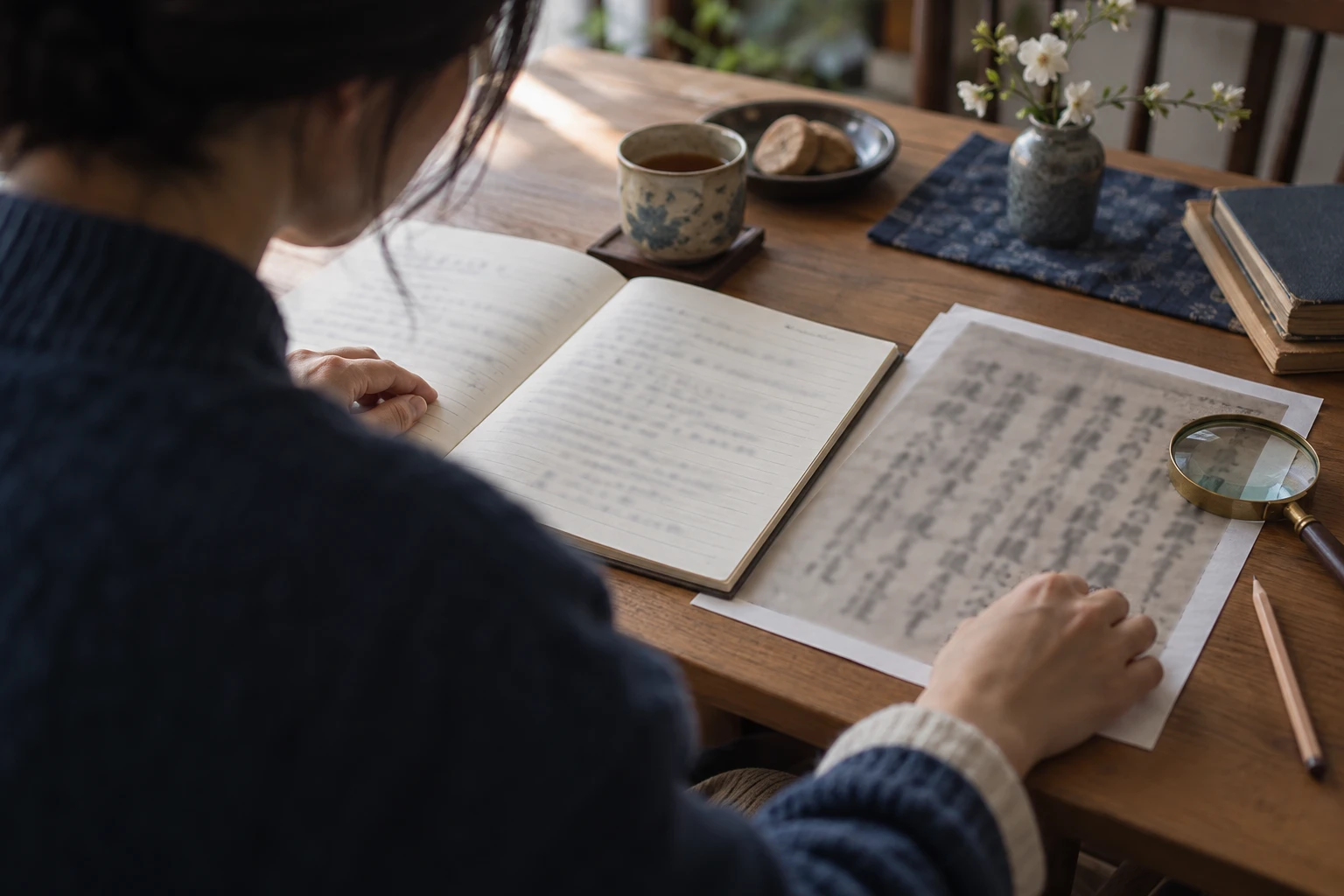
Reading and translating. Registers made before computerization are handwritten, often in older characters, with dates in Japanese eras — for example Meiji (1868–1912) or Taisho (1912–1926). Careful reading takes time, and it's not a step to rush: one misread character in a surname can lead to the wrong family.
If you'd like to go further — local histories, a visit to the family grave, or planning a trip to the hometown — that adds time, because these sources aren't in one place.
Why can't requests to Japan be faster?
Requests from abroad move at the pace of the post, and paying more or asking more often doesn't change how quickly a town office replies. Each office handles requests in its own order, and the reply is mailed back.
A few practical details also take time to arrange:
Fees are 450 yen per current register and 750 yen per closed or older register, normally paid with Japanese postal money orders (teigaku kogawase), which are hard to get outside Japan.
Proof of descent. Under the Family Register Act (Article 10), direct ancestors and descendants can request registers without a reason, but the request must show your line. Gathering birth and marriage certificates for each generation can take a while.
The 2024 one-stop service doesn't help from abroad. Since March 2024, people in Japan can request registers from all over the country at one counter, but only in person in Japan, for themselves, their spouse or their direct line — not by mail or through someone else.
What can make the search go faster?
The most helpful thing you can do is prepare: a known registered home, a confirmed spelling of the surname and your own chain of certificates can each save weeks. Try these steps:
Gather your direct-line certificates — birth, marriage and death — back to the ancestor born in Japan.
Search records in your own country for a prefecture or village: ship lists, censuses and naturalization files.
Photograph anything with Japanese writing, front and back.
Write down every spelling of the family name you find.
If you have a specific goal — confirming a birthplace before a trip, for example — it can help to focus on that first and widen the search later.
Why do some searches reach a dead end?
Some searches stop earlier than hoped because certain old registers no longer exist. Closed registers are now kept for 150 years, but until 2010 the rule was 80 years, so some older registers were lawfully destroyed. War and disasters also caused losses in some places.
This isn't something anyone can speed up or fix, and it's better to know about it from the start. Even so, the registers that do survive often reach ancestors born in the early to mid-1800s, because the oldest generally available format, from 1886 (Meiji 19), records people who were already alive then.
How can you use the waiting time well?
The weeks spent waiting for replies are a good time to gather family stories, photos and documents that will bring the finished tree to life. Ask older relatives what they remember, label old photographs, and note any places or names that come up. When the registers arrive, these details help make sense of them — and turn a list of names into a family story.
In summary
In our experience, a Japanese family search often takes a few months, mostly depending on what you already know.
Time goes to finding the registered home, postal requests that each take a few weeks, and careful reading.
Preparing your certificates and clues in advance is the best way to save time.
Every step brings you a little closer — and the moment a great-grandparent's name appears on an old register is well worth the wait.
How TADOROOTS can help
We help Nikkei families abroad plan their search realistically and build a family tree they can keep. We review what you already have, work out which registers to request and from which town, prepare the paperwork for a direct-line descendant's written authorization, then read the old registers and build an English family tree and report. We share findings as they're confirmed, so you see the tree taking shape along the way. You can see how our step-by-step pricing works — the first step is small, so you know what is possible before deciding more. We can work with you in English, Chinese, Korean or Japanese.
Frequently asked questions
Q. How long does it take to trace Japanese ancestors?
In our experience, it often takes a few months. The biggest factors are whether the family's registered home is known, how many generations you want to trace, and how many rounds of postal requests are needed.
Q. How long does one koseki request take from abroad?
Each exchange by post commonly takes a few weeks. Requests are made in Japanese to the town office of the family's registered home, and fees are normally paid with Japanese postal money orders.
Q. Can paying more make the research faster?
Not for the postal requests themselves. Town offices reply in their own order, whatever the budget. A wider scope adds depth, such as more generations or more sources, rather than speed.
Q. What is the best way to speed up my search?
Prepare in advance: find the registered home if you can, gather birth, marriage and death certificates for your direct line, and photograph anything with Japanese writing on it.
Q. Can I see results before the whole search is finished?
Yes. Registers arrive one at a time, so findings can be shared as they are confirmed, and you can watch the family tree take shape before the final report.
Q. Why might some old registers be missing?
Until 2010, closed registers were kept for 80 years, so some older ones were lawfully destroyed. The period is now 150 years. Some records were also lost in wars and disasters.
Q. Can I use Japan's 2024 nationwide service to save time?
Only in Japan. Since March 2024, registers can be requested from anywhere in the country at one counter, but only in person, for yourself, your spouse or your direct line. It cannot be used by mail or through someone else.