Planning a Trip to Your Japanese Ancestors' Hometown
Published Updated By TADOROOTS Research Team
Maybe the idea came up at a family gathering. Someone said, "We should go to Japan and see where Grandpa's family came from," and everyone agreed — and then nobody was quite sure where "there" actually was. A prefecture name, perhaps. A village someone remembers hearing about. A photo of a hillside grave.
If you're at that point, you're far from alone. Many Nikkei families dream of this trip for years before they take it. And here is the encouraging part: a roots trip works best when the research comes first, and with the right records, an exact village, a family register and sometimes a family grave can be found before you ever leave home.
We're the research team at TADOROOTS in Tokyo. We read old Japanese family registers every day to build family trees, including for Nikkei families abroad. In this article you'll learn:
what research to finish before planning the trip
what you may realistically find in an ancestral hometown
how to deal with villages that have changed names
what to know about visiting a family grave in Japan
What research should be done before the trip?
Before booking a roots trip, you want to know the family's registered home (honseki) at the village level, confirmed by the family register (koseki), not just a prefecture. That is what gives the trip a real destination.
Compare these two starting points:
"My family was from Kumamoto Prefecture." — a large area with dozens of towns and villages
"The koseki shows the family registered in this village, with a great-great-grandfather born there in 1863." — a place you can actually stand in
The koseki is kept by the town office of the family's registered home, and it often names the village, the head of the household and earlier generations. That's why, in our experience, the trip is best planned after the koseki research is largely complete. The itinerary is built around what the research has already found.
What might you find in your ancestral hometown?
What you find varies a great deal: sometimes a busy town, sometimes a quiet rural landscape with a family grave, and occasionally relatives who still live nearby. Both quiet and lively outcomes are common, and neither means the research failed.
Things that can make a visit meaningful include:
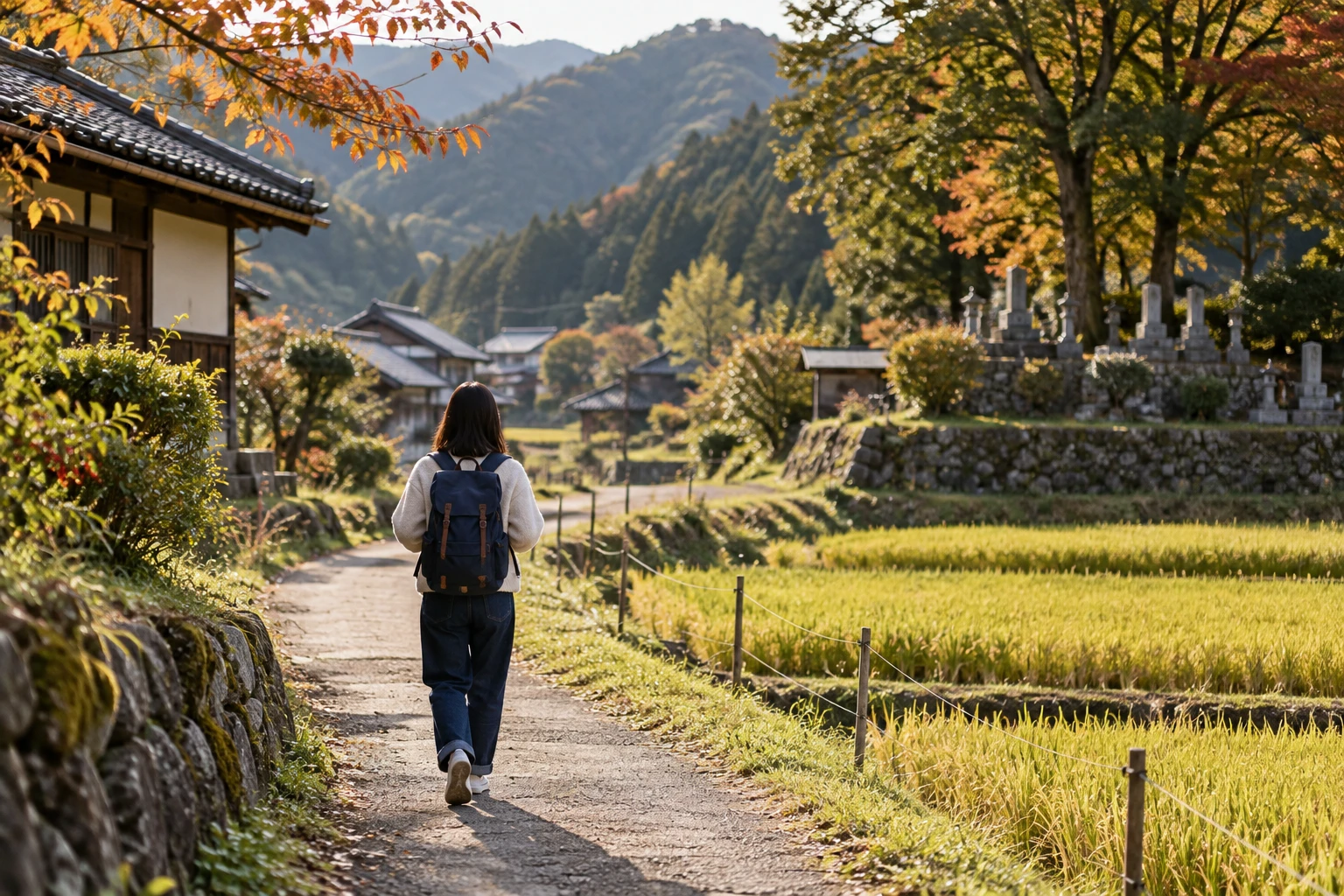
The village landscape — rice fields, hills or a coastline your ancestors would recognize
A local shrine or the family's temple (bodaiji), if it is known, where you can pay your respects
A family grave, if its location has been confirmed
The area around the registered address, even if the original house is gone
Many rural areas of Japan have lost population over the decades, so some villages are much smaller now than when your ancestor left. It helps to arrive expecting a place to stand and remember, rather than a reunion — and to treat any meeting with relatives as a welcome bonus, arranged only if they are already in touch with your family and happy to meet.
What if the village has changed its name?
A village named in an old record has often merged into a larger town or city, but the historical place can still be matched to today's map. Japan's municipalities have been reorganized many times; between 1999 and 2014 alone, their number fell from 3,232 to 1,718.
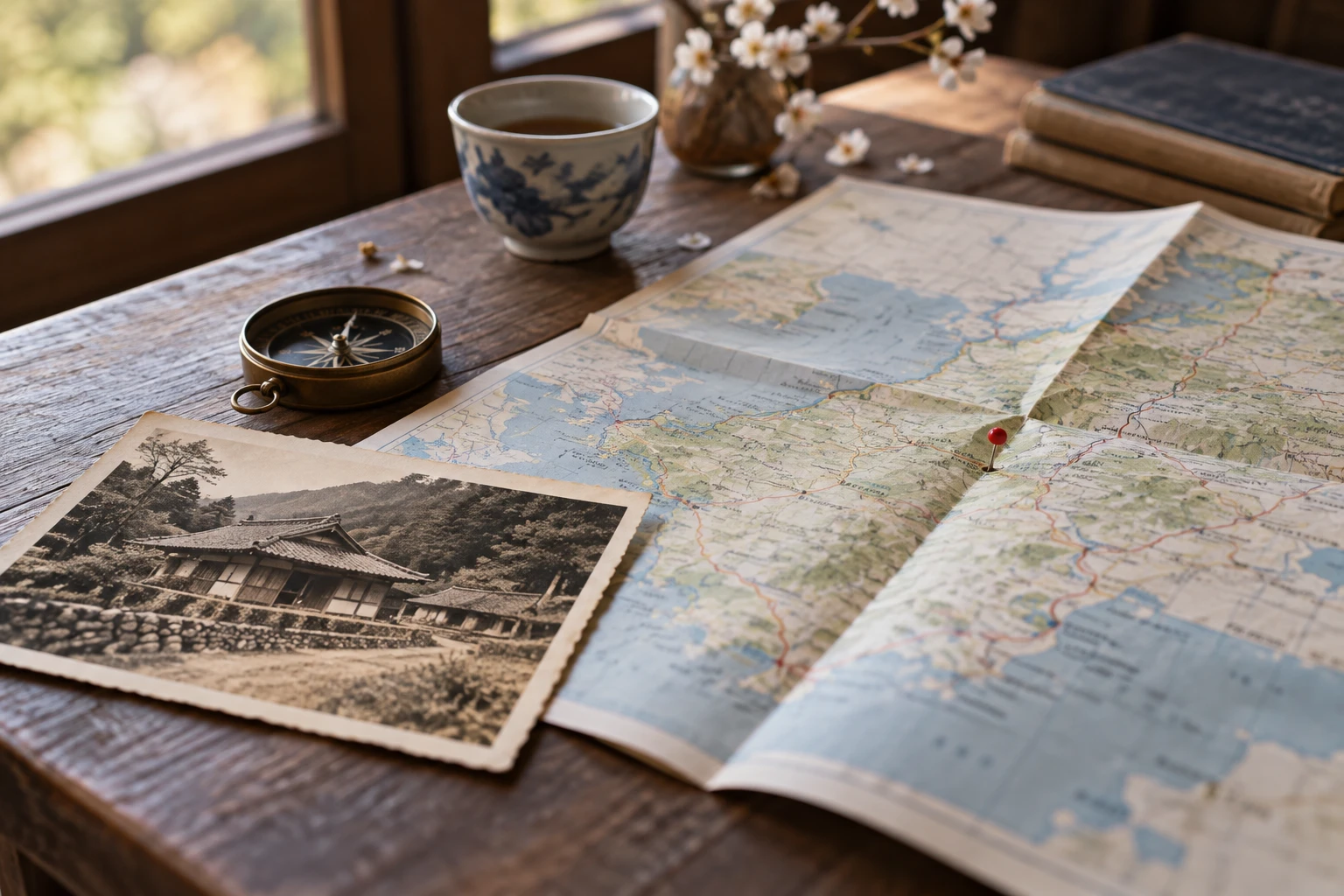
For example, a register might give an address in a "mura" (village) that no longer appears on any map. That village may now be one district of a city with a completely different name. Matching the old address to the modern one is part of the pre-trip research, so you don't arrive and find nothing on the ground that matches the record.
A few other details are worth checking before you go:
whether the registered address is written as a land lot number (chiban) or a block number, which affects how precisely it can be placed
how far the place is from the nearest station, since rural bus services can be infrequent
what the season will be like; snow, typhoons and the summer heat can all change plans
How do you visit a family grave in Japan?
Visiting a family grave in Japan usually means cleaning it gently, offering water, flowers and incense, and putting your hands together in a quiet moment of respect. You don't need to perform it perfectly; sincerity is what counts.
Typical steps include:
Tidy the grave — pull small weeds and wipe the stone.
Pour water over the gravestone, often with a ladle and bucket provided at the cemetery.
Offer flowers and light incense.
Put your hands together and bow quietly.
Some practical notes help too. Many cemeteries ask visitors to take food offerings home afterwards. Family graves in the countryside often stand on temple grounds or community land, so keep to paths and behave as a guest. If you do meet relatives who have welcomed the visit, a small gift from your home country (temiyage) is a common and appreciated gesture.
How long should the trip be?
In our experience, a day or two in the ancestral hometown is often enough, usually as part of a wider trip to Japan. Rural towns can be quiet, with few hotels, so many visitors stay in a nearby city and travel out for the day.
A simple plan might look like this:
Day 1: arrive in the nearest city, rest and review the family tree and records
Day 2: visit the registered address area, the shrine or temple and the family grave
Day 3: spare time for weather, a local museum or simply walking the area
Leaving some slack in the schedule matters more than you might expect. Many families tell us the moment of standing in the village is quieter and more emotional than they imagined, and they're glad they didn't rush it.
In summary
Finish the koseki research first, so the trip has a confirmed village and, if possible, a family grave.
Old village names have often merged into new towns; matching them to today's map is part of the preparation.
Visiting a family grave is simple — clean, offer water, flowers and incense, and bow quietly.
Standing where your ancestors lived often makes the family tree feel real in a way no document can.
How TADOROOTS can help
We help families abroad build the family tree that a roots trip is built on. We work out which registers to request and from which town office, prepare the paperwork for the written authorization (power of attorney) of a direct-line descendant, then read and translate the old registers into an English family tree and report. From there, our Japan Roots Tour can help you plan a visit around the places the research confirmed, with local arrangements made in advance. You can see how our step-by-step pricing works, starting with a small pre-research. We can work with you in English, Chinese, Korean or Japanese.
Frequently asked questions
Q. What should I know before visiting my ancestors' hometown in Japan?
It helps to know the family's registered home at the village level, confirmed by the koseki, and to match that old address to today's map. With that, the trip can focus on the right village, the family grave if it is known, and nearby places of meaning.
Q. Can I find my ancestral village with only a prefecture name?
A prefecture alone is usually too broad, since each one contains many towns and villages. The exact village is normally found through the family register, often starting from clues such as passenger lists, naturalization papers or gravestones.
Q. What if my ancestor's village no longer exists?
Many villages have merged into larger towns and cities, but the historical place can usually be matched to a modern district. This matching is done as part of the research before the trip.
Q. Will I meet living relatives in Japan?
Sometimes, but it should not be expected. Many families find a quiet landscape and a family grave instead. A meeting is best arranged only when relatives are already in touch with your family and happy to meet.
Q. How do I visit a family grave in Japan?
Typically you tidy the grave, pour water over the stone, offer flowers and incense, and put your hands together with a quiet bow. Many cemeteries ask visitors to take food offerings home afterwards.
Q. How long should we stay in the ancestral hometown?
Often a day or two is enough, with an extra day for weather or rest. Many families combine the hometown visit with a wider trip to Japan and stay in a nearby city.
Q. Do I need to visit Japan to do the research?
No. Family registers are requested and returned by post on the authorization of a direct-line descendant. The trip comes later, once the research has found the place.